The celebration of Halloween originated from a Catholic festival named All Hallows’ Eve, which was the day before All Saints’ Day. It was a Christian celebration to commemorate all those who died in the faith. All Saints’ Day, Nov. 1, was the day to decorate gravesites of the faithful. Over the years, cemeteries and ghosts have become synonymous with Halloween, and scary stories of cemeteries are as traditional as costumes and trick-or-treating. During the remaining 364 days, our cemeteries are places of peace and beauty, of spiritual contact between the living and the dead.
Chesterfield County has a wealth of history in its cemeteries and in people who maintain, record, and discover their ancestry. The cemetery committee of the Chesterfield County Historical Society was formed shortly after the historical society started over 20 years ago. The committee’s goal is to record all the cemeteries in the county. According to Patti Grady, who was a member of the committee before her passing in 2018, they are busy every week, locating and recording historical cemeteries. She said in a 2003 VN article: “We find them in different places, accidentally and in deeds. We get permission from the property owners to find the graveyard. Then we research obituaries and death records to see who is buried there. It is a very interesting committee, and we have a good time.”
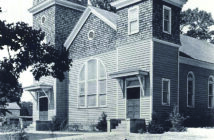
Saint Ann Catholic Cemetery is part of the St. Ann Catholic Church on Jefferson Davis Highway. Bohemian immigrants erected the Church of Saint Ann off Harrowgate Road in 1924. As a customary practice, the cemetery was started behind the church, with the first interment in 1929. Throughout the years there were 52 recorded burials, with the majority of those being the original Bohemian immigrants. The church was demolished shortly after Saint Ann relocated to Jefferson Davis Highway in 1954. Most of the family names of the immigrants in the cemetery, those with names like Kuzelka, Kohout, Skalicka, and Novak have died off. A few of the original families remain members of the church. In the 2003 article, Betty Michalek said that she and her brothers, Joe and Frank Hotz find much of their family history lies in the cemetery. The Hotzes have a family plot there where their grandparents are buried. They grew up attending the church and know the history of each person buried there.
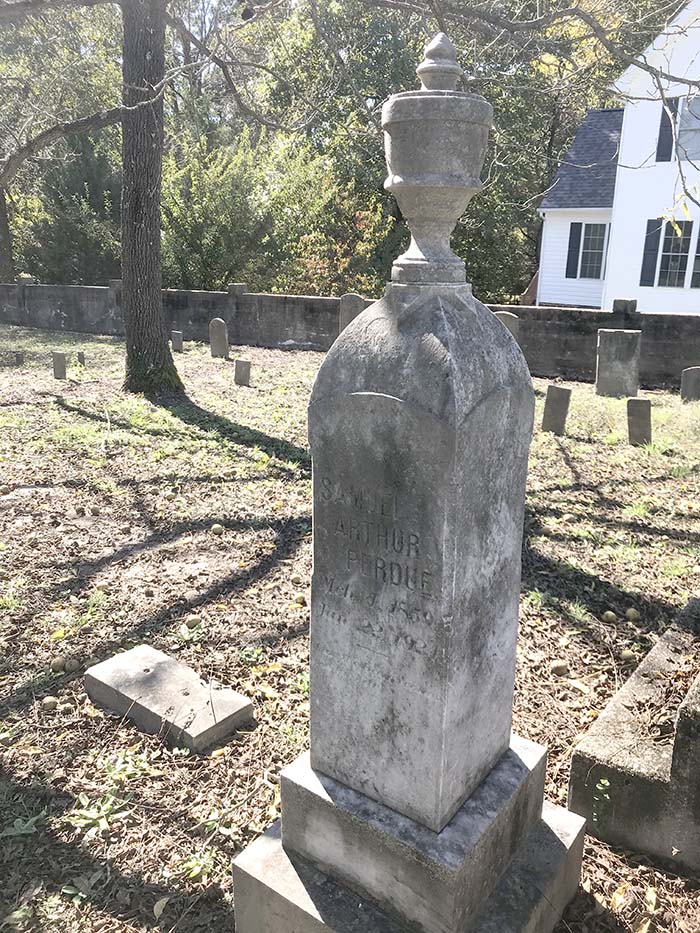
As our communities develop and farms become residential developments, many old and forgotten family cemeteries are being adopted by their new neighbors. The family plot that may have had stories of being haunted is now becoming a very peaceful and beautiful part of the landscape. Caretakers are stepping forward to maintain these abandoned plots and cherish the opportunity. The Perdue cemetery in Warfield Estates is one great example of a community embracing its past. It is part of the landscape of the front yard of one resident there. Kandis Alerassool, owner of the Perdue cemetery in Warfield Estates is also the caretaker of the cemetery. Alerassool purchased her home in Warfield Estates on September of 1998, and her property included the Perdue cemetery. She and her neighbors have been caretakers of the cemetery over the years.
The late Mike Dubus was co-chairmanship of the Saint Ann Cemetery committee to provide a vision for the future of the cemetery. About the same time he recognized encroachment from a new development near a cemetery that has been out of sight for over 100 years. He felt the need to have that cemetery, to protect it. So, with an approaching birthday, he said to his wife, “Here’s what you can get me for my birthday.” It was the Snead Cemetery, with Captain J.L. Snead as the first interment in 1881. On his marker, which stands at least 15 feet, is: “Captain J.L. Snead, a brave Confederate soldier.” The Dubus family owns two-thirds of the cemetery. In 2003, he said there are mostly Sneads buried in the cemetery, along with some Fitzpatricks.
The most ghostly of tales concerning cemeteries would be that of the Lady in Red, who is said to have been seen over the years in Wrexham Hall. It is said to be Susannah Walthall, the daughter of Wrexham’s original owner, Archibald Walthall. When he died, he left the property to his daughters, Polly and Susannah. The sisters sold off much of the property but stipulated according to their father’s wishes that a portion of the property that contained the family burial ground be left undisturbed. Over the years, a later owner knocked down the gravestones, and over time the burial ground was lost. The late Judge Ernest P. Gates moved his family into Wrexham in 1979. As reported in “The Ghosts of Richmond…and nearby Environs” by L.B. Taylor Jr.. Gates’s wife, Gee Gee, reported many times that family members and guests heard unexplained footsteps and voices. It was also written that Gates felt that the sightings might have been Susannah still searching for her family graveyard.
According to Grady, when Gates sold the property to People’s Bank of Virginia, who developed Chesterfield Meadows Shopping Center, an area had to be designated for the Walthall family cemetery. It is not known where the exact location was originally, so today a sacr where the rests in a squared island of landscape in front of the Goodwill collection center in the former Ukrop’s parking lot.
The cemetery committee at Saint Ann Catholic Church wrote in its history of the cemetery that a cemetery “is a place of spiritual contact between the living and the dead. It is the place where two real worlds meet and commune.” Grady was asked all the time if she is ever afraid of the dead people. She said in the 2003 Village News article, “The dead people are not going to hurt me; it is the live ones that I am sometimes afraid of.”